
About Our Founder
Chris Knuth: A Pathfinder in Two Worlds
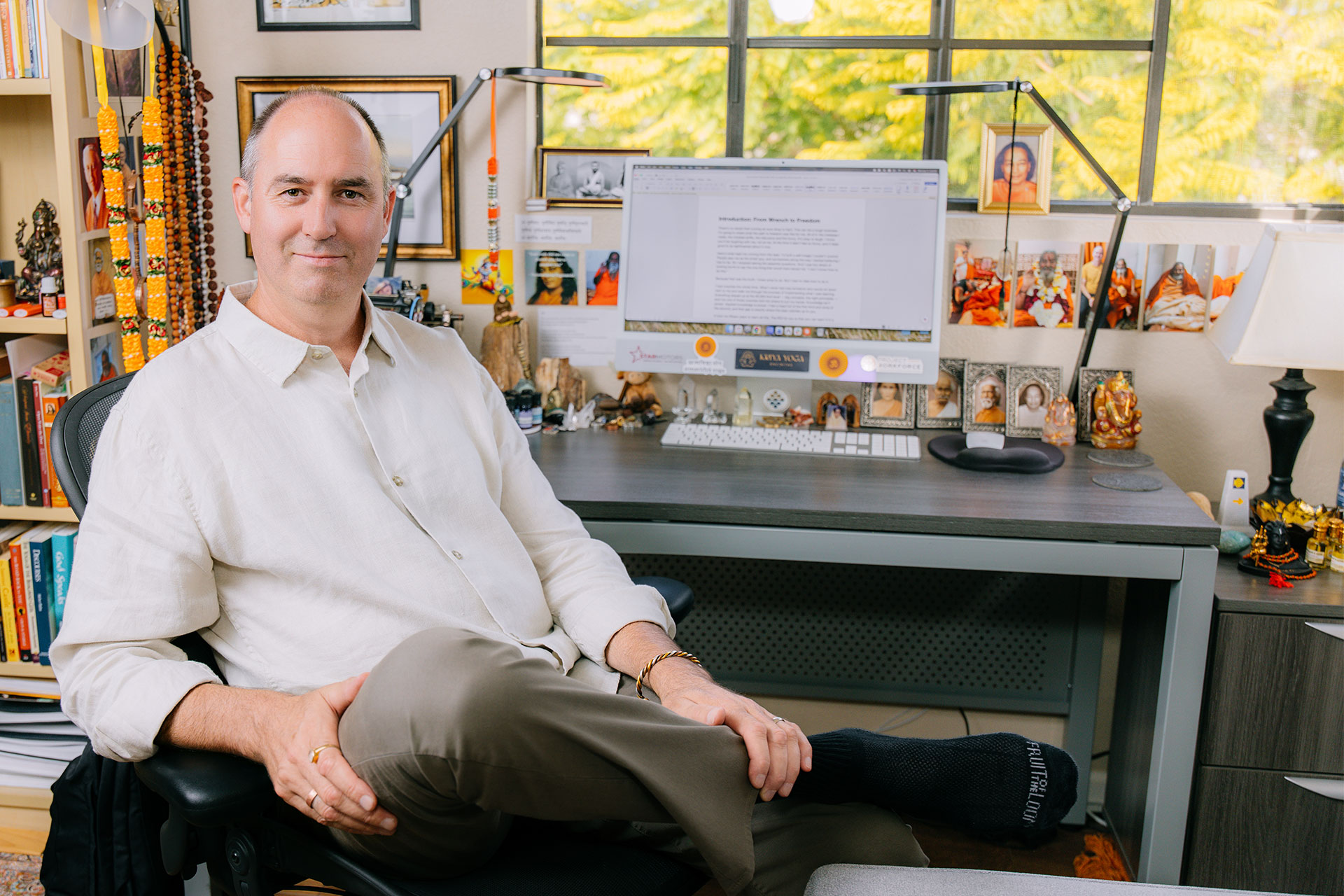
Ātmavidyā Yoga was created by Chris Knuth, who walks through life with two toolboxes.
In one hand, he carries wrenches and business plans. He runs a neighborhood auto repair shop in San Juan Capistrano, California, coaches small business owners, and built a program that teaches job skills to veterans, formerly incarcerated individuals, and people starting over in recovery. He knows how to fix cars and help people build steady lives.
In his other hand, he carries the ancient tools of meditation, Sanskrit study, and Kriya Yoga. He has spent years learning from wise teachers in the US, Europe, and India, discovering how to calm the mind and look deeply inside.
To Chris, these two hands belong to the exact same path. Meditation isn't a secret door to run away from your life—it is a clear lantern to help you walk through it with kindness, courage, and peace.
How Ātmavidyā Yoga Came into Being
Every long journey begins with a single step. Here is how Chris walked from hitting a wall in his everyday life to building a welcoming space for self-discovery:
Hitting a Wall & The Six-Month Challenge
In the spring of 2018, I hit a wall.
By then, recovery had already changed my life. The Twelve Steps had given me a practical spiritual path and introduced me to prayer, inventory, service, surrender, and the uncomfortable but liberating work of looking honestly at myself.
But I sensed there was another level of understanding available. I just didn't know how to reach it.
Around that time, I was listening to a recorded talk by Mark Houston about the Eleventh Step — prayer and meditation. He told a story about someone complaining that meditation didn't work. Mark asked how long the person had been practicing. A couple of weeks.
His response was essentially: if you haven't at least meditated every day for six months, you haven't practiced long enough to decide whether meditation works or not.
I took that as a challenge.
So I began sitting every day.
Discovering the garden next door
For months, I mostly fumbled around. Then a friend casually mentioned "Yogananda and the Great Ones."
After he left, I searched the phrase.
Paramahansa Yogananda. Autobiography of a Yogi. Self-Realization Fellowship.
And, remarkably, Encinitas.
I had lived near this tradition and visited the meditation gardens for years without understanding what was right in front of me.
I read Autobiography of a Yogi, and something opened.
Questions I had carried for most of my life — about God, consciousness, religion, suffering, purpose, and why we are here — suddenly had a framework that made sense. More importantly, the teachings pointed toward something that could be experienced rather than merely believed.
I wanted to know for myself.
That desire became the beginning of a much longer journey.
Deepening the study
I immersed myself in Yogananda's teachings and eventually in Kriya Yoga. In 2021, I entered Ryan Kurczak's two-year Kriya Yoga apprenticeship. Through that relationship, I began studying the tradition more seriously and eventually met Isha Das and Swami Nirvanananda at the Assisi Institute in Rochester, New York.
Not long afterward, Ryan asked whether I would consider becoming a teacher in the Kriya Yoga tradition.
At the time, it seemed to explain something about my life. I had spent decades teaching and leading in business, recovery, mentoring, and service. Perhaps all of it had been preparing me for this.
For several years, I pursued that path seriously.
But spiritual life has a way of dismantling the identities we build around it.
Eventually, the question changed from How do I become a teacher? to something more difficult:
What is actually true in my own experience?
That question changed everything.
The Yoga Sūtras as a Mirror
In April 2023, Ryan asked me to write a commentary on Patañjali's Yoga Sūtras.
I felt completely unqualified.
I started anyway.
What began as a writing project became an examination of my life. I worked through all four pādas, studying the Sanskrit, traditional commentaries, Kriya Yoga, and the philosophical context of the text.
But Patañjali kept following me off the page.
The Sūtras began showing up in recovery, marriage, business, ambition, resentment, attachment, fear, and service.
They stopped being philosophy.
They became a mirror.
I completed the first full journey through the manuscript in 2025, but the book was not finished with me.
The Unadorned Thread: A Contemporary Commentary on the Yoga Sūtras of Patañjali eventually grew beyond 100,000 words. I could have rushed it toward publication.
Instead, I realized something:
I needed to deepen.
The manuscript continues to evolve as my own understanding evolves.
There is something fitting about that.
A book about yoga should not outrun the yoga of the person writing it.
Journeys to India
India changed the trajectory of my practice.
In early 2025, my wife, Emma, and I traveled to Puri, Odisha, where we spent time with Isha Das, Swami Nirvanananda, and fellow devotees from Europe. We visited students we had helped support, spent time at the Karunalaya Leprosy Care Center, and meditated in the Samadhi Temple of Swami Sri Yukteswar.
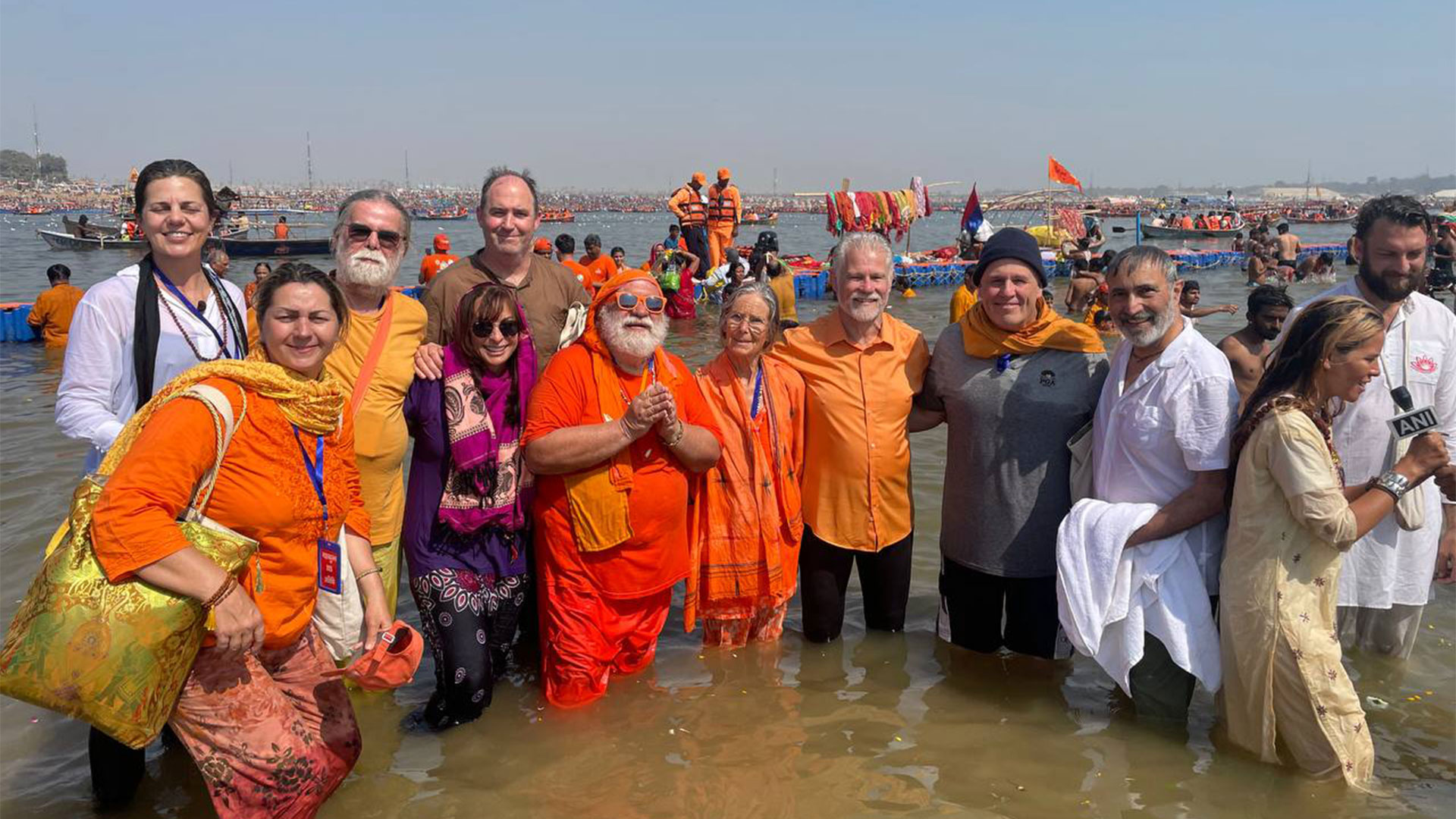
From Puri, we traveled to Prayagraj for the Maha Kumbha Mela.
Millions of pilgrims converging at the Sangam. Meditation and pūjā. Kīrtan and exhaustion. Illness and laughter. Sādhus, relentless noise, smoke, cold mornings, friendship, and moments of extraordinary grace.
It disrupted many of my ideas about what spiritual life was supposed to look like.
Then, in early 2026, I returned to India alone.
That journey changed me more deeply.
I spent several weeks in Haridwar studying and practicing in the presence of Swami Yogananda Parivrajak — Guruji — and other teachers whose depth of practice forced me to reconsider what I thought I understood.
Again and again, I was pointed toward simplicity.
Practice. Attention. Surrender. Direct experience.
Guruji gave me an extraordinarily simple instruction:
Keep OM at the spiritual eye and stay inside.
Not as something to explain.
As something to practice.
My teachers also encouraged me not to rush the Yoga Sūtras book. There was more to understand — and, more importantly, more to embody.
They were right.
Founding Ātmavidyā Yoga
For several years, I thought the destination of this journey was ordination or recognition as a Kriya Yoga teacher. Eventually, I began to see the subtle problem.
I was in danger of turning spiritual practice into another identity to achieve.
So I stepped away from that goal.
I retired the name Kriya Yoga Encinitas and created Ātmavidyā Yoga — not because I rejected Kriya Yoga or the teachers who had helped me, but because I needed enough space to discover what was genuinely mine to teach and what still belonged to someone else's framework.
Ātmavidyā means knowledge of the Self.
That is the heart of this work.
Not collecting spiritual information.
Not adopting another identity.
Not becoming impressive at meditation.
Knowing what we are beneath the conditioning, fears, ambitions, wounds, roles, and stories we ordinarily mistake for ourselves.
And learning to live from that understanding.
The householder is the practice.

I am not a monk.
I am a husband, entrepreneur, author, employer, coach, friend, student, and teacher. I run businesses. I make payroll. I negotiate contracts. I make mistakes. I experience irritation, ambition, fear, attachment, disappointment, love, grief, and uncertainty.
For a long time, part of me imagined that spiritual practice happened somewhere else — on the meditation cushion, in an ashram, at a retreat, or during some elevated state of consciousness.
I don't believe that anymore.
Deep meditation matters enormously.
But eventually we have to stand up.
Then someone disappoints us. A business problem appears. A relationship becomes uncomfortable. Someone criticizes us. We don't get what we want.
That is where the practice becomes visible.
Can I recognize resentment before it becomes action?
Can I tell the truth when doing so costs me something?
Can I see where fear is masquerading as wisdom?
Can I remain present when my conditioning wants to defend, control, withdraw, impress, or be right?
This is where meditation, the Bhagavad Gītā, the Yoga Sūtras, recovery, and ordinary life converge for me.
The world is not interfering with my practice.
The world is revealing it.
Walking
Together
I used to think being a spiritual teacher meant arriving somewhere.
I don't anymore.
Some of the deepest lessons of the last few years have come through discovering how much I still don't know — and how easily spiritual knowledge itself can become another identity.
India has helped me see that.
Marriage has helped me see it.
Recovery has helped me see it.
Business has helped me see it.
My students have helped me see it.
And meditation continues to show me.
So I don't teach from above my students.
I practice alongside them.
Ātmavidyā Yoga grew out of that understanding.
It is a place for serious spiritual practice without pretending we are somewhere we aren't. A place where ancient teachings meet relationships, work, recovery, service, meditation, and the complicated reality of being human.
The aim is not to become more spiritual.
It is to see more clearly.
To become less governed by conditioning.
And, ultimately, to know the Self not simply as a teaching we have inherited, but as a reality we discover for ourselves.